How or whether to block hand knits, especially garments, is a perennial question. Over the years—in books, at finishing workshops, and in classes—I've encountered many different recommendations, everything from "always wet block," to "always block using a professional-quality steamer," to "I never block at all."
In my opinion, whether or how to block depends on the project, the yarn, and even the recipient. When I knit a catnip toy for my cat, for example, I don't block it.
I'm in the "wet block" camp and think most things look better after being wet blocked. But what that consists of will vary from one project to the next. A lace shawl that's been knit with laceweight yarn on large needles might get a very long (45–60 minute) soak in cold water and Eucalan, so that when I stretch it out on blocking wires, the yarn is fully saturated, allowing the lace to open up beautifully.
Here's my
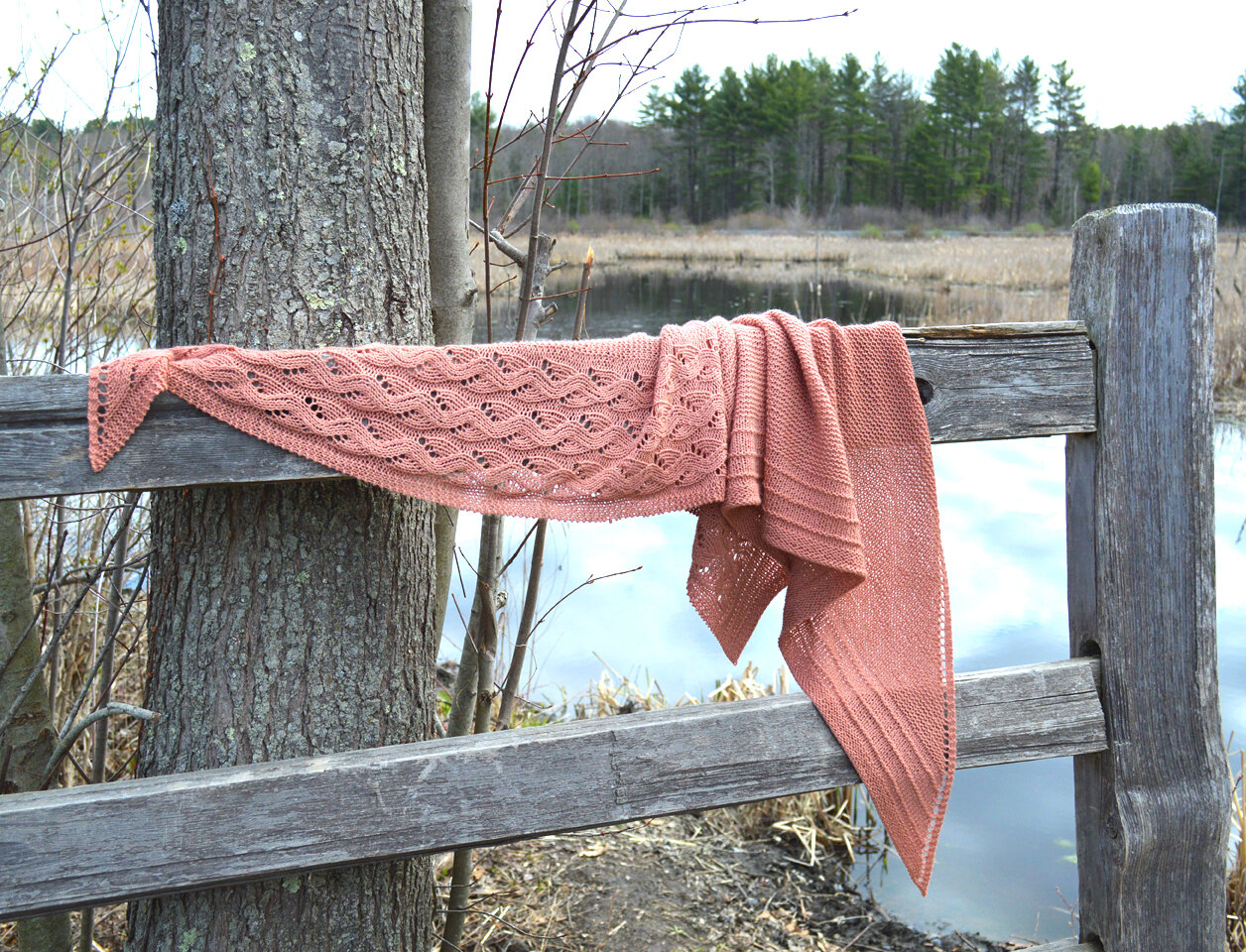
Anita Carolina scarf being blocked:
Before blocking, the beauty of the lace was hidden; the edges rolled and the scarf looked like a crumpled mess:
Another example—my
Birchleaf cowl before and during blocking:
I like using blocking wires for scarves, cowls, and shawls. They help me to achieve smooth, even edges and they make stretching out the lace and making sure the width is consistent throughout the piece quite easy. But they're not strictly necessary; here's a lace swatch being blocked with just pins (the top half is narrower than the bottom because I switched to a smaller needle halfway through):
I usually give a sweater a shorter soak, perhaps 30 minutes, after which I'll roll it in a towel or two to squeeze out excess water, then lay it out over a sheet or towels on a flat surface. I pat it gently into the desired finished dimensions, and let it air dry.
My newest sweater design,
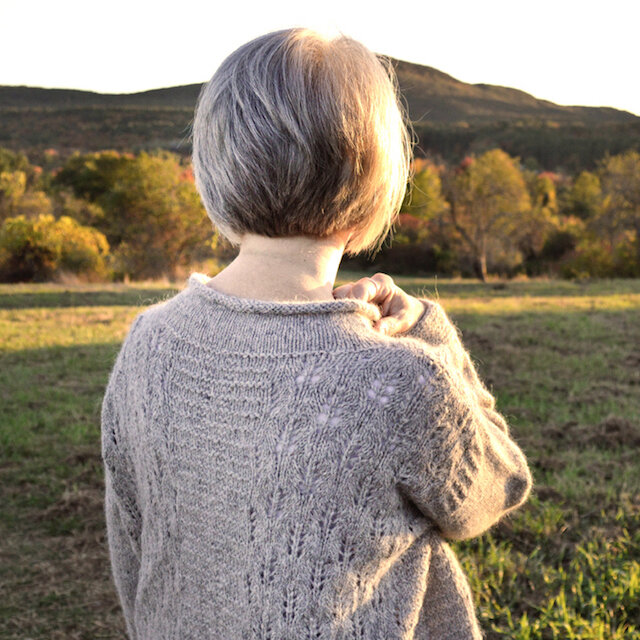
Briscoe, presented an interesting blocking challenge: much of this top-down cardigan is stockinette or garter stitch, but the front bands and collar are lace. And the lace rolled up quite a lot before blocking:
I knew from my swatches that the lace on Briscoe wouldn't need severe stretching—just a little encouragement. After soaking it in a Eucalan bath for about a half hour, I laid it on towels and used pins only on the front bands, to gently open up the lace and encourage the wavy edges:
A substantial swatch allows you to determine the gauge you can expect after blocking (it also lets you see if the yarn you've chosen is a good fit for the design, as well as practice techniques in the pattern). After knitting a large gauge swatch, I wet block it exactly as I will wet block the finished piece. If the swatch grows after blocking, then my mind is at ease if the sweater seems a little snug as I'm knitting it. Wool and alpaca relax with blocking, and a slightly snug fit will usually become "just right" after a sweater is blocked. (Unless, of course, you've knit a size that's much too big, in which case you'll either have to start over, or gift the sweater to a larger person.)
My reason for wet blocking garments is quite practical: unless a sweater is going to be a store sample and will never actually be worn, it's going to need washing. Wet blocking lets me see what will happen once the garment is washed. If the yarn's going to grow in length or width after washing, I want to know that before I start knitting, so I can knit the appropriate size, or adjust my needle size, or maybe even choose a different yarn. So I wet block my swatch(es) the same way I will wash the sweater, and I take note of how the yarn behaves. If a swatch of 50 stitches grows a quarter inch in width after blocking, then I can expect 200 stitches to grow at least an inch.
How do you block your hand knits? I'd love to hear your tips and tricks.